Our Woman in Havana by Vicki Huddleston
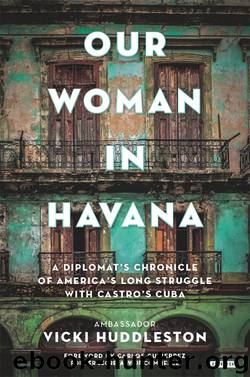
Author:Vicki Huddleston [HUDDLESTON, VICKI]
Language: eng
Format: epub
Tags: BIO026000, BIO010000, POL011010, HIS041010
ISBN: 9781468315806
Publisher: The Overlook Press
Published: 2018-02-13T05:00:00+00:00
CHAPTER 11
THE BEST OF ENEMIES: GUANTANAMO NAVAL BASE
FIDEL CASTRO ONCE DECLARED THAT “GUANTANAMO BASE IS A DAGGER plunged into the heart of Cuba.” Castro never reconciled himself to what he perceived as the US occupation of Cuban territory, but he was also wise enough not to directly attempt to dislodge the United States. Since the early 1990s, so-called fence-line talks between the United States and Cuba have led to mutually cooperative military relations that have benefited both countries. Still, the Castro regime longs to regain the territory over which Cuba retains “ultimate sovereignty,” yet cannot exercise that sovereignty so long as the Treaty of 1934, which superseded the Treaty of 1903, provides the United States “complete jurisdiction and control” over the land on which the base is situated. The US government agreed to pay Cuba two thousand gold coins annually for use of the base, an amount that has been determined to amount to the modest sum of $4,085. Since taking power in 1959, neither Fidel nor Raúl Castro has ever cashed the annual checks delivered by the US government. The treaty also stipulates that the territory on which the base is situated will only be returned to Cuban jurisdiction when either both governments consent to its return or the United States abandons the facility. It is this provision that has allowed the US military to occupy the territory for well over one hundred years.
Guantanamo Naval Reservation, often referred to as Guantanamo Bay or in more recent years just Gitmo, is located along Cuba’s southeastern coast, forty-eight miles from Santiago de Cuba, where the US Navy destroyed the Spanish Fleet on July 3, 1898. Protected by the Cuzco Hills and encircled by two mountain ranges, the Sierra Maestra in the west and the Sierra del Maguey in the east, the deepwater port at Guantanamo Bay consists of forty-five miles of land and sea, shaped like a figure eight, of which the United States occupies the lower half and Cuba controls the upper half.
Guantanamo Bay exemplifies the contradictions and myths of US-Cuba relations. Despite the widespread belief—or myth—that we have sovereignty over the naval base, we do not. The US presence in Guantanamo Bay contradicts our general practice because it is the only military base in the world that we occupy over the objections of the host government. I saw this contradiction firsthand when, in the early 1990s, I watched as a freighter flying the Soviet Hammer and Sickle steamed through the waters of the base on its way to the Cuban town of Caimanera, which is situated in the upper half of Guantanamo Bay.
In the early years of the revolution Castro planted eight miles of opuntia cactus along the northeast perimeter, dubbing his creation the Cactus Curtain. He also created one of the largest minefields in the world, thereby isolating the US naval base from the rest of Cuba. During the Cold War, the Cuban Frontier Brigade yelled obscenities at US Marines, who in turn “mooned” the Cuban soldiers from a watchtower that overlooks Cuban territory.
Download
This site does not store any files on its server. We only index and link to content provided by other sites. Please contact the content providers to delete copyright contents if any and email us, we'll remove relevant links or contents immediately.
Waking Up in Heaven: A True Story of Brokenness, Heaven, and Life Again by McVea Crystal & Tresniowski Alex(37876)
Empire of the Sikhs by Patwant Singh(23138)
We're Going to Need More Wine by Gabrielle Union(19111)
Hans Sturm: A Soldier's Odyssey on the Eastern Front by Gordon Williamson(18653)
Leonardo da Vinci by Walter Isaacson(13414)
The Radium Girls by Kate Moore(12097)
Tools of Titans by Timothy Ferriss(8501)
Educated by Tara Westover(8119)
How to Be a Bawse: A Guide to Conquering Life by Lilly Singh(7551)
Permanent Record by Edward Snowden(5908)
The Last Black Unicorn by Tiffany Haddish(5687)
The Rise and Fall of Senator Joe McCarthy by James Cross Giblin(5319)
Promise Me, Dad by Joe Biden(5193)
The Wind in My Hair by Masih Alinejad(5142)
A Higher Loyalty: Truth, Lies, and Leadership by James Comey(5020)
The Crown by Robert Lacey(4869)
The Iron Duke by The Iron Duke(4409)
Joan of Arc by Mary Gordon(4160)
Stalin by Stephen Kotkin(4010)
